
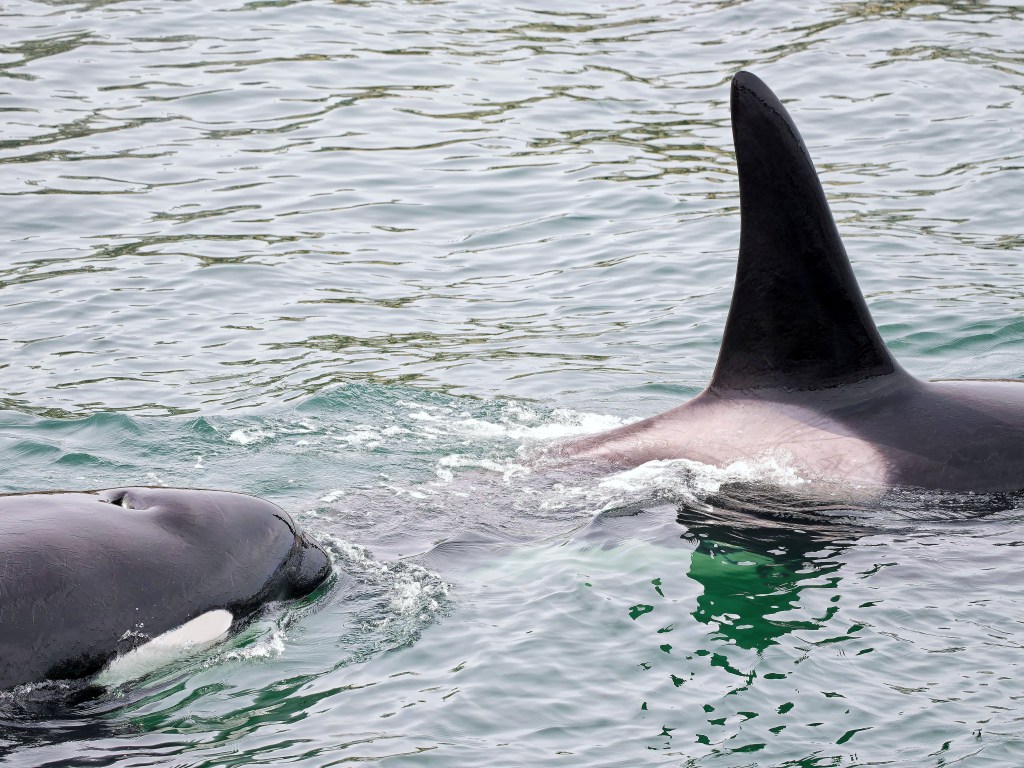
The story of Bigg’s Killer Whales T049A1 “Noah” and T069E “Kodiak”
11 September 2026
There are few things more fascinating than watching a killer whale family move through the waters of the Salish Sea.
Bigg’s killer whales are highly intelligent, social animals with complex family relationships. Their lives are deeply connected to their matrilines, with mothers and offspring often travelling together for years.
So when a male killer whale begins spending significant amounts of time away from his family, it naturally raises questions.
Why would a whale with living family members choose—or perhaps simply end up—travelling independently?
And what happens when two seemingly unrelated “lone wolves” meet?
That is the intriguing story unfolding around T049A1 “Noah” and T069E “Kodiak.”
T049A1 “Noah” was born in 2001, the first offspring of matriarch T049A “Nan.”
T049A1 “Noah” — Nan’s firstborn
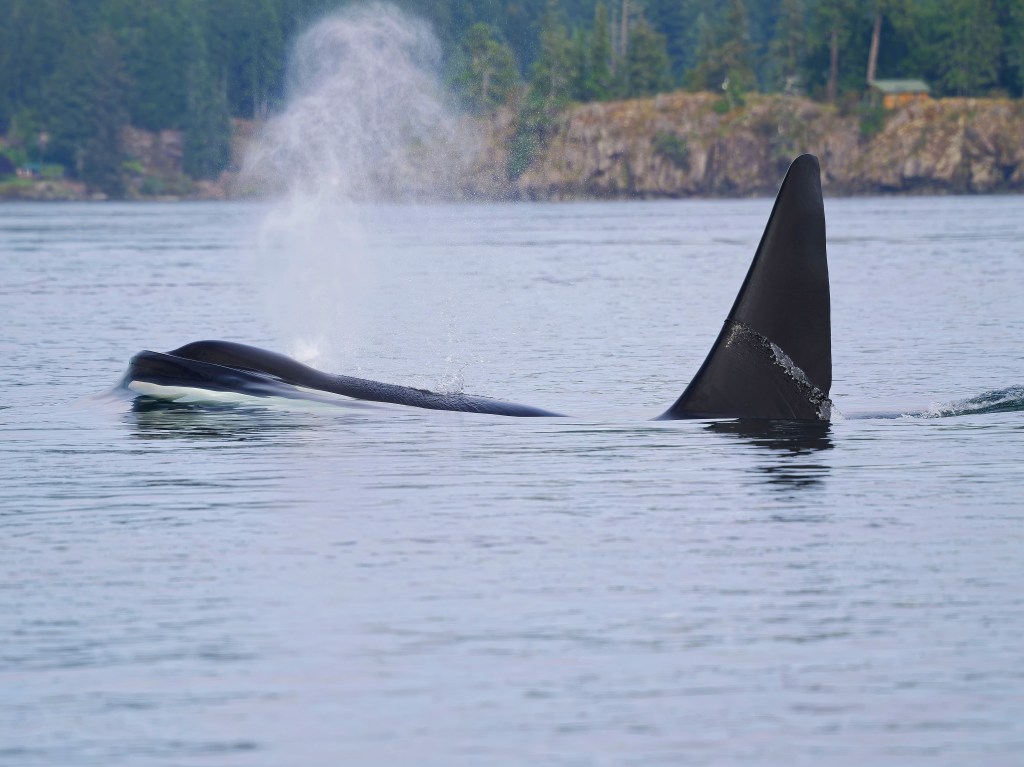
Nan is a prolific matriarch, with seven known offspring, all living to date. Noah has periodically split away from his matriarchal family over the years, but his independence appears to have become more pronounced following the birth of Nan’s sixth offspring, T049A6 “Charlie II,” in 2022.
Noah isn’t without family. His mother and siblings are still part of the Salish Sea’s complex network of Bigg’s killer whales.
Yet, at times, he has chosen—or circumstances have led him—to travel apart from them.
T069E “Kodiak” — Komox’s son
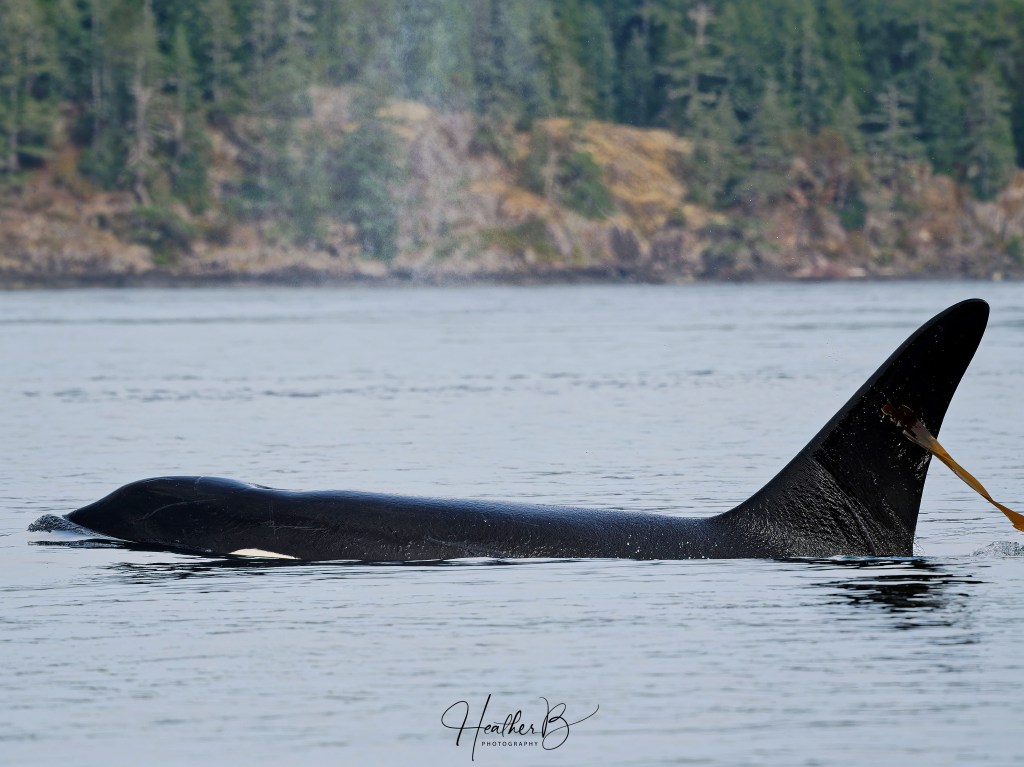
T069E “Kodiak” was born in 2004 and is the son of matriarch T069 “Komox.”
Like Noah, Kodiak has living family members. He occasionally reunites with his mother and siblings, but much of the last two years has been spent travelling independently.
Kodiak has a particularly interesting connection to Campbell River.
On July 17, 2025, he was observed in Campbell River travelling with his mother, Komox, and his siblings.
Almost to the day one year later, on July 18, 2026, Kodiak was back in Campbell River.
But this time, he wasn’t travelling with his family.
He was travelling with Noah.
And that is where the story gets really interesting.
Two lone wolves meet
Solo males—or what we might affectionately call the “lone wolves” of the Salish Sea—are not an everyday occurrence.
That makes the behaviour of Noah and Kodiak particularly intriguing.
In some cases, a lone male may simply be the last remaining survivor of his matrilineal family.
A well-known example is T011A “Rainy.” His immediate family line has passed on, leaving him without surviving close family members travelling alongside him.
Rainy is a survivor.
He continues to navigate the vast waters of the Salish Sea without the immediate family relationships that once surrounded him.
But Noah and Kodiak are different.
They have family.
So why have they spent so much time apart?
Is independence part of the strategy?
There are several possible explanations.
One possibility is that periods of independence are temporary and serve a purpose.
For males, dispersal away from their immediate family may provide opportunities to encounter potential mates outside their close maternal relationships. Because males generally remain closely associated with their mothers and matrilineal families, travelling beyond that immediate group could potentially reduce the risk of inbreeding.
But perhaps we don’t always need to search for a complicated explanation.
Could some males simply have a preference for travelling independently?
Could independence itself be a strategy?
Or could it be a combination of circumstances, social relationships, food availability, reproductive opportunities and individual personality?
We don’t know.
And that uncertainty is part of what makes observing these whales so fascinating.
Noah isn’t the only one
Noah’s brother, T049A2 “Jude,” provides another interesting example.
Jude split away from Nan’s group in 2013 and has subsequently been observed travelling alone as well as associating with other whales.
On various occasions, he has been seen travelling with individuals outside his immediate family, including T051 “Roswell.”
This suggests that separating from a matrilineal group doesn’t necessarily mean a whale becomes permanently isolated.
A male can move between social arrangements—sometimes with family, sometimes with other whales, and sometimes alone.
But what happened when Noah and Kodiak found each other?
A meeting that raises questions
From the online reports I could gather, there appeared to be no previous documented reports of T049A1 Noah and T069E Kodiak travelling together.
Then, suddenly, this past week, something changed.
The two males were independently observed in and around the Nanoose Bay / Nanaimo area.
Within days, they were together in Campbell River.
Not simply travelling in the same general area.
They appeared to be “tied to the hip.”
The pair approached Campbell River from the south and were observed near Stories Beach, travelling close to the Vancouver Island shoreline.
They then crossed over to Quadra Island, where they briefly encountered another group: T023 / T023Ds and T100s, who were travelling together from the northeast.
For a moment, there was an opportunity to become part of a much larger gathering.
But the party didn’t last long.
Before there was enough time to accurately count fins, Noah and Kodiak crossed back over to Vancouver Island.
And then they continued north, hugging the shoreline.
Together.
They remained in extremely close association—often within metres of one another—as they travelled toward Menzies Bay / Race Point.
Why each other?
This is the question that keeps coming back.
What catalyzed this new relationship?
As far as the available reports indicate, Noah and Kodiak were not previously known as travelling companions. There is no obvious history of the two being regular associates.
They appear to be unrelated males from different matrilines who, until recently, had been travelling independently.
And yet, somehow, they met.
And they stayed together.
Even when they encountered a larger group.
That detail is particularly intriguing.
They had an opportunity to associate with other whales, including members of multiple matrilines.
Instead, they separated from the larger group and continued on their own.
Together.
Communication beneath the surface
Watching killer whales interact raises another fascinating question:
How were Noah and Kodiak communicating?
Killer whales have sophisticated communication systems, including vocalizations, physical interactions and social behaviours.
During observations of Noah and Kodiak, there were several instances of apparent tactile interaction.
Their enormous pectoral fins and massive bodies were seen in close contact as they travelled.
Was this simply part of their normal movement?
Was it social bonding?
Was it play?
Was it communication?
Or perhaps some combination of all three?
We cannot know from observation alone.
But the physical closeness was striking.
For two males with no previously documented history of travelling together, their apparent comfort with such close contact certainly invites speculation.
Strangers in a vast ocean
Perhaps the most remarkable part of this story is how unlikely the encounter seems.
Two males.
Two different matrilines.
Living relatives, but both spending considerable time away from their families.
Apparently unrelated.
No known history of travelling together.
They meet somewhere in the enormous expanse of the Salish Sea.
And then they stick together.
It almost sounds like the beginning of a story rather than a wildlife observation.
Yet this is precisely what makes long-term observation of wild killer whales so rewarding.
We see individual whales repeatedly. We learn their names, their family histories, their matrilines and their recognizable markings.
But despite years of observation, there is still so much we don’t understand about their individual choices and relationships.
Perhaps Noah and Kodiak simply crossed paths at the right time.
Perhaps they discovered that travelling together offered some advantage.
Perhaps there was a social connection that observers had simply never witnessed before.
Or perhaps, like humans, they just chose each other’s company.
Lone wolves… together
Perhaps “lone wolf” isn’t quite the right description anymore.
Noah and Kodiak may have separated from their respective matrilines, but they have now demonstrated something equally fascinating:
A male doesn’t necessarily have to choose between family and solitude.
There may be a third option.
Friendship.
Partnership.
Temporary alliance.
Or simply companionship.
We don’t yet know what this new association means or how long it will last. They may remain together for days, weeks, months—or perhaps their paths will eventually diverge and they will return to their respective families.
That is the beauty—and frustration—of studying wild whales.
We don’t get to write the ending.
We simply get to watch.
For now, two lone males from two different matrilines have found each other in the vast waters of the Salish Sea.
They met by chance, travelled together, encountered a larger gathering, chose to leave it, and continued north side-by-side.
T049A1 Noah and T069E Kodiak.
Two “lone wolves.”
Perhaps they weren’t looking for each other.
But somehow, they found each other.
And for now, they’re sticking together.
UPDATE: T049A1 Noah and T065A3 Amir
T049A1 Noah slid south during the night and was seen late on the next day on 12th September 2026 in Union Bay with a NEW travelling buddy, T065A3 Amir.
Where did Kodiak T069E end up? is he back to being a lone wolf?
and where did Noah find Amir? how long will this new alliance last?


